
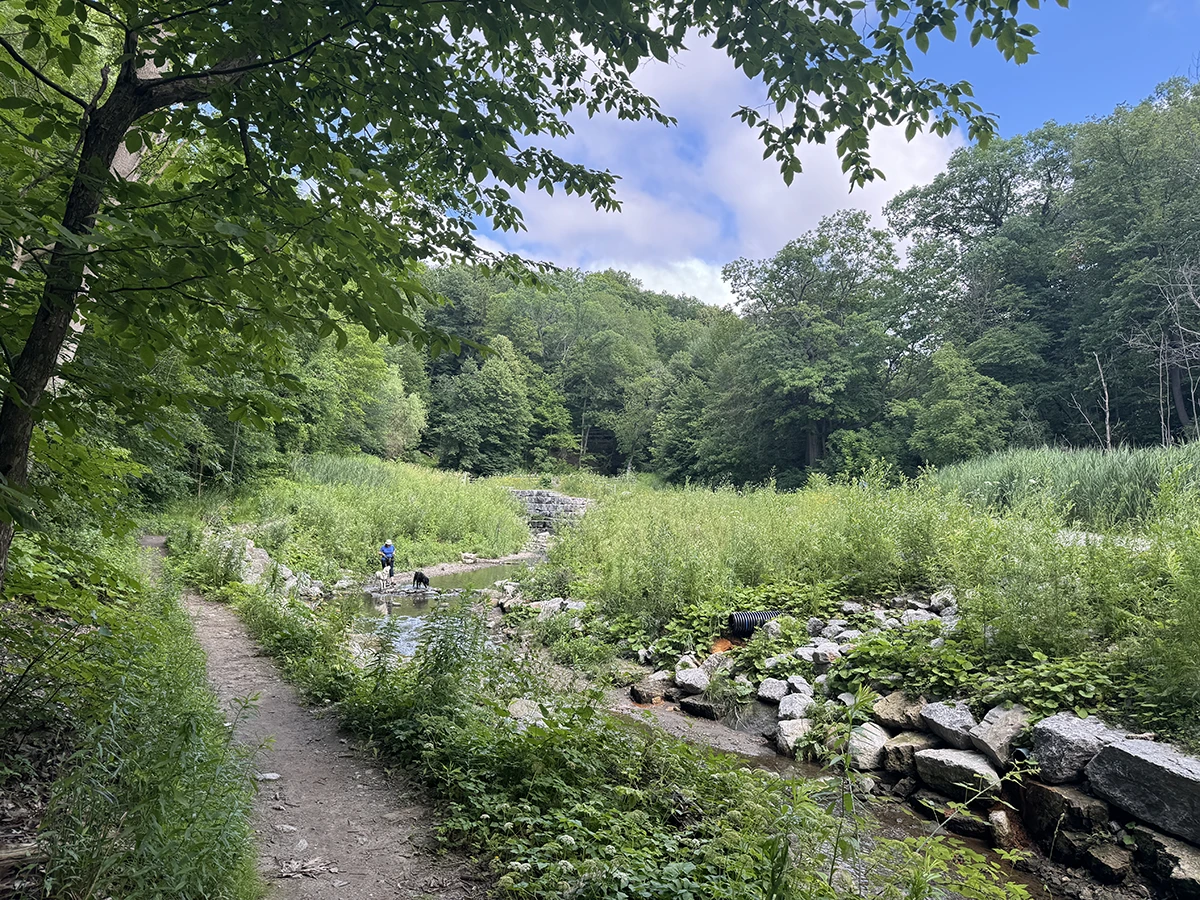
The program for the rehabilitation of the Vale of Avoca is beginning to take shape. While we will keep you updated, the City has now opened a project page where you can follow along. You can also sign up for updates on the site by clicking on the Get Involved tab.
Critically it is expected that there will be a public consultation in October, and this will be an opportunity for you to hear about the scope of the project and share your views.
Separately, we continue to follow some other meaningful projects, which should smooth pedestrian movement through the Vale and around our neighbourhoods.
Heath Crescent Staircase
This is a project which will ease the traverse between Deer Park and Moore Park and provide our Moore Park neighbours a safer descent into the ravine while addressing erosion issues on the slope.
- Target tender release Q4 2026
- Construction start late Q1 2027
St. Clair Staircase
The staircase is located on a tricky site due to erosion and other issues. Engineering alternatives will be presented to the TRCA in late Q4 2026.
Ecological Survey
This summer, the Midtown Ravines Group (MRG) of which the DPRG is a member, sponsored an ecological survey of the entire Vale, the first such conducted since 2013.
While the survey found that the ravine still contains a significant mature oak forest, it is becoming clear that, without active management, Norway maples will continue to expand and crowd out native species. Norway maples are especially concerning because they suppress understory vegetation, reduce biodiversity, and contribute to slope erosion, and managing them must therefore be central to long-term efforts to stabilize the Vale of Avoca.
Other survey highlights:
- Currently Norway Maple is the dominant tree species sitting at 57.1% of trees per hectare within the ravine
- Mature oaks remain an important component of the Vale, but there appears to be limited oak regeneration in a few areas. Notably the oak trees are gradually dying off and being replaced with the faster growing, invasive Norway maples.
- Norway Maple is already a major component of the forest in several areas and, because of its abundance in all stages of the forest, it has the potential to become increasingly dominant over time if not properly managed.
- Other key sensitive species exist within the ravine and may be impacted by growing stressors if not properly managed.
- Invasive species are not distributed evenly across the Vale. The mapping identified areas where management could be prioritized to protect higher-quality native vegetation and reduce further spread.
- Invasive species are concentrated in high traffic and disturbed areas such as trails, roadways and the creek edge.
The survey itself was conducted by Urban Forest Associates (UFORA) with students in forestry at the University of Toronto’s Daniels Faculty of Architecture, Landscape, and Design.
The study provides us with a current inventory of plant populations to support an integrated plan for addressing the ravine’s degraded condition. It will also help establish a foundation for an official long-term management plan for the Vale of Avoca Environmentally Significant Area (ESA). Finally, the findings will support educational and volunteer stewardship activities that create important opportunities for community engagement.